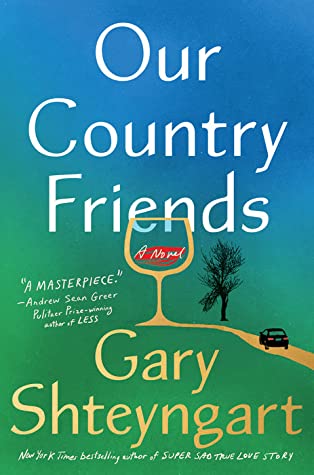
Review: “Our Country Friends” by Gary Shteyngart

Intense, funny and charged with the nervous fear of the early days of the COVID-19 pandemic, Gary Shteyngart’s “Our Country Friends” blends a classic “country estate” novel with our all-to-familiar dystopian present.

As the novel begins, writer Sasha Senderovsky (a bit of a Shteyngart fill-in) invites a group of old friends to stay at the country house he shares with his therapist wife and their adopted daughter. There’s a main house and a series of little bungalows, surrounded by dying trees and sharing creaky plumbing, problems that Sasha doesn’t have the money to fix.

Our host is past his prime earning potential and hoping for a TV script to come through. This long-delayed project brings a bonus guest to the estate: a famous actor, unnamed, who is developing the script with Sasha. This partnership leaves Sasha beholden to the actor’s good will, even as the confined star stirs up the already tense “pandemic meets ‘Trump-country'” environment.

Sasha and his friend are decidedly not Trumpers. They are mostly immigrants, high school friends from New York City who’ve seen a range of success. A failed adjunct professor/grease monkey at his uncle’s restaurant is still hung up on his high school crush, who’s recently hit it big as the tech guru behind the “Tröö Emotions” app. There’s also a trust fund bon vivant and a former student of Sasha’s who grew up poor, rural and white and isn’t above stirring up culture-war resentments for publicity.

It’s a good cast, each distinct, prickly and lovable at the same time. They drink too much and fall into cliques (as well as in and out of one another’s beds). They tend toward the libertine, with outdoor sex and plenty of skinny dipping in the pool.

They also occupy an elevated social class, even if some of them, like Sasha, are doing so on credit. (He winces at a four-figure liquor tab but still signs the check.) Indeed, one of the book’s rare missteps is when Sasha’s student, Dee, obliviously reveals just how well-padded her bank account is. It’s an unlikely gaffe for someone who is supposed to have grown up counting every penny.

There are plot engines–an app that bewitches one of the guests, a social media scandal, a black truck that periodically sits outside the gates. And there’s the great ghost of COVID looming over everything, haunting our guests as they seek refuge from the dirty world outside.

Shteyngart captures the uncertainty of the early days of the pandemic, the hollow gestures of hygiene theater, the understandable paranoia and the countervailing desire to get drunk and hug your oldest friends around the neck. That said, “Our Country Friends” transcends the pandemic, addressing larger issues of friendship and success, betrayal and heartbreak. I thought it lingered too long in its final fadeout (like COVID itself, I suppose), but it was still a warm and rewarding read.

Quotes

“At their lower moments, they always overcame their parents’ programming, always offered each other more than they had ever been given.”

***

“She remembered the little fishes her father had used to bait the sea bass of Long Island Sound, the way they used to thrash on the hook, unsuitable for anything but dying between the teeth of a more important animal.”

***

“People were dying in the city. Some more than others. The virus had roamed the earth but had chosen to settle down there, just as the parents of Masha, Senderovsky, Karen, and Vinod had chosen it four decades ago as a place to escape the nighttime reverberations of Stalin and Hitler, of partition, of the pain that radiated not to distant memory but cracked outright from their own fathers’ hands.”

***

“Senderovsky watched his wife in the sundress return to her patients and her child’s lesson plans and thought of the raft of mystery that floats between two partners, even contented ones, as they turn in for the night. He wished he could fall in love with someone as his wife evidently had done. He had chased after beauty for such a long part of his life, until he had caught up with it and found it, like everything else, worthy of no more than a chapter or two of heightened prose.”

Book Review: “Tunnels” by Rutu Modan

Israeli comics creator Rutu Modan assembles a lively fictional cast for “Tunnels,” which sees a crew of oddballs conducting a DIY search for the Ark of the Covenant.

The story is sparked by a clue discovered on an old cuneiform tablet. The excavation is led by Nili, a single mother and former archaeology wunderkind who’s trying to settle some old family business. It’s funded by an antiquities collector who’s not very particular about where his treasures originate. (ISIS is on speed dial.)

A crew of Orthodox “settlers” provide the muscle for the dig, motivated by faith/political concerns. There’s also a dastardly professor who screwed Nili’s dad out of tenure, some Palestinian colleagues from a long-ago field season and even a couple knuckleheads who claim they’re with ISIS, although it seems like they can barely tie their shoes.

Modan follows the excavation as it tunnels into Palestinian territory, bringing her cast together to squabble and scheme. The art is colorful and evocative, like something Herge might draw, although not so neat. Her figures tend to be a bit squat and ugly, but they have plenty of personality.

Modan’s best work is done juggling the voices of her cast. She captures the little details that distinguish each group, all while maintaining enough individuality so that no one comes off like a cliche. The plotting tends toward the zany, but it’s clever and fun and offers surprises all the way up to the end. Modan also doesn’t shy away from the political subtext of life in Israel, both contemporary and Biblical, but her ultimate message is individualistic and deeply human.

“Tunnels” doesn’t wrap neatly. Instead, it offers something more ambiguous, winking out with a bit of dark humor that would be happily at home in a Coen Brothers film. It’s creative and memorable, a real accomplishment.

Book Review: “Picture This” by Joseph Heller

In “Picture This,” Joseph Heller uses Rembrandt’s portrait of Aristotle with a bust of Homer as a device to analyze avarice and empire, traveling from ancient Athens to mercantile Amsterdam all the way into the present day. In his trademark style, Heller uses repetitive, layered storytelling–much as a painter uses brushstrokes–to illustrate his central theme: that power is derived from cruelty.

There isn’t much of a narrative to advance this thesis. We do get scenes of Rembrandt in his workshop, applying and removing paint as he ponders how to dodge his creditors. But much of what Heller offers is synopsis, selections from the Greek classics: the trial of Socrates, the plague of Athens, the siege of Melos. He uses these pieces of history, like a lawyer building a case, to argue for the essential futility of the human condition. Warmongers profit, Heller tells us. Innocent people are massacred, enslaved, exploitatively forced to toil. Thus it ever was, and thus it ever will be.

In sketching this pattern, though, Heller finds himself drawn to the outliers. Take Rembrandt, for instance. The painter is a crude man. He squanders his childrens’ inheritances, impregnates his housemaids, takes on debts he’ll never repay. He stitches old canvases together to try to make a buck from frustrated patrons. And yet he is exquisite in conjuring the gilt of gold or using a few brushstrokes to evoke the contours of lace.

There is something inexplicable about Rembrandt, a bit of the divine, even if he never benefits from it. Instead, he dies bankrupt while his paintings appreciate in the hands of counts and wealthy widows.

Socrates too is unique. The philosopher opts out of the striving and cruelty of his ancient home; he walks away from a dictator’s orders, accumulates nothing, has his wife dump a chamber pot on his head. Put on trial for blasphemy and corrupting the youth, he defends himself, arguing that he deserves a pension from the state for his work. He refuses compromise, contrition, escape and exile, sticking to his principles…that and a large glass of hemlock.

It’s worth noting, as Heller does, that Socrates risked his life for Athens, taking up arms multiple times as a common soldier on the city’s behalf. These actions were pointless–everything seems pointless to Socrates, at least in Heller’s telling–but he did it anyway. One has to serve the empire one is born into, Socrates suggests. In this service, it’s easy to see a parallel to John Yossarian in “Catch 22” and Heller’s own combat experience in World War II.

Like most of Heller’s books, “Picture This” argues that the world is senseless and arbitrary and often cruel. In transmuting history into fiction, it also argues that history isn’t really knowable. Many of the paintings credited to Rembrandt are forgeries. Socrates’ words are passed down to us through Plato, who was only a child when many of them were uttered.

And so like Socrates, Heller makes a show of flaunting his ignorance, highlighting what he doesn’t know–what can’t be known. We never learn anything from history it seems. Only that the same dark patterns keep recurring.

Quotes


“Nowhere in history is this assumption that human life has a value borne out by human events.

All our religions but the Judaic and the Greek think more of us dead than alive.”

***

“Rich is the country that has plenty of poor. In periods when prosperity is general, the value of the impoverished to that country increases, and nations not rich in poor must import indigents from inferior countries for the labor now considered degrading for citizens of repute to perform.

The bidding sometimes goes high.

It is fortunate for the progress of civilization that there are always plenty of poor.”

***

“War is always in fashion, my dear old friend. Look at our history. In our golden age of Athens there is scarcely a period as long as five years in which we have not been at war. We lost most of the big battles and can’t hold on to what we win. Yet the city prospers, the economy booms. And now see how unconvincing and feeble poor Nicias appears each time he comes into public to argue for threadbare, ragged, tedious peace. A politician can roar for war. For peace he can only plead.”

Book Review: “But You Seemed So Happy” by Kimberly Harrington

In “But You Seemed So Happy: A Marriage in Pieces and Bits,” writer Kimberly Harrington explores the voluntary dissolution of her marriage with dark humor and brutal honesty. On the balance, though, the book tends more toward the latter, making for an uneven, unhappy read.

As Harrington admits in the introduction, this book about her divorce didn’t have a great inciting incident. There wasn’t infidelity or scandal; thankfully, there’s no abuse or deep betrayal. Instead, the slow fadeout of her marriage falls into the classic category of “irreconcilable differences,” and she spends these pages trying to examine just how they got to that point.

The memoir walks us through the romance-adjacent portions of Harrington’s life: her parents’ divorce, her high school longing, a move to Portland, meeting her husband, getting married, moving into a dilapidated farmhouse and having kids. From there, it becomes a slow, steady fizzle, a marriage drained of its love like a soda going flat.

As a life path, it feels common enough. And while the author is adept at expressing her frustration–with her marriage, with her husband, with the patriarchy–it doesn’t seem like she fully lands the larger point she’s trying to make. On the whole, Harrington is skeptical about marriage. She argues, fairly, that there shouldn’t be anything shameful or embarrassing about a several-decade relationship coming to an end. She even has a chapter, “Things People Say When You Get Divorced That They Really Should Say When You Get Engaged.” But despite her best efforts to avoid off coming off as “the divorce witch,” her tone feels more personally aggrieved than anything. She sounds bitter.

Part of the issue is that we’re getting a one-sided account of the relationship. Her husband is only present in her telling; he has his own perspective on all of this, one we only get glimpses of when he refers to her as “high strung” in a text she snoops on or takes issue with Harrington entering a Tinder flirtation during their separation without telling him. On the whole, though, he comes off as a good guy, decent and honest. Harrington gives him full credit for these positive traits, but the reader spends a lot of the book wondering where the problem is exactly.

Part of the challenge is that Harrington poses as a no-holds-barred truthteller, but she doesn’t seem to put herself under the same microscope that she applies to her husband and society. As she admits at one point, a point of contention for her husband is that she has “different rules” for herself. The book supports that. Harrington often comes off as aggressive and self-absorbed, too caught up in what others think. It seems she felt the need to write a book-length memoir about why she was justified in getting a divorce instead of just getting one. (Spoiler: at the end, the couple is separated but still married and living in the same house.)

Harrington certainly raises some thoughtful points, about her marriage and everyones’, and the bitter humor can be entertaining. But she’s better at expressing her frustration than diagnosing what’s going on. When she looks back at the past, her tone can be nostalgic and sweet, but when she writes about wanting to put a fist through a wall because of her husband’s chewing, it just feels rant-y.

On the deepest level, “But You Seemed So Happy” feels like a lament about how she was supposed to be a special, cynical, smart young thing and instead has to go through the same dumb aging and disappointments and making a living that everyone else does. Unfortunately (and granted, this is a dude saying this), it happens to the best of us.

Quotes

“I thought I didn’t care what he did and I would be happy for him when he moved on, because I was now an Evolved Person. Instead, I was shocked at how flashy and visceral my jealousy was. He could move on after I moved on! I’d be happy for him after I was happy with myself first!”

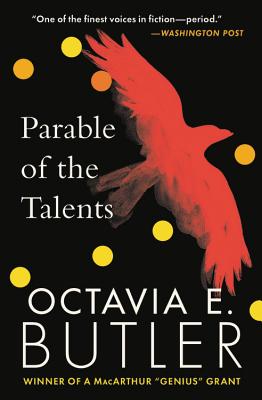
Book Review: “Parable of the Talents” by Octavia Butler

Octavia Butler’s dystopian “Parable” series reaches a powerful conclusion with “Parable of the Talents.” The book’s premise feels alarmingly familiar. It’s set in a nearly collapsed United States, one beset by climate change and rising religious fascism. Penniless migrants head north on foot to try to start new lives in Canada or Alaska, but they’re threatened the whole way by criminals and slavers.

Our lead character is Lauren Olamina, a young black woman who is a community leader and the founder of a new faith, Earthseed, that posits that God is Change and that humanity’s destiny is to work together to venture out into the stars. As “Parable of the Talents” starts, though, Lauren are her small community are stuck in decidedly earthly circumstances, living a “nineteenth century existence” in a community they’ve built on a patch of land in northern California.

Given all the trauma these characters have experienced–murder, kidnappings and worse–it seems like a safe haven. But then things go wrong. Few authors are better at having things go wrong than Butler. She’s a master of the sudden reversal, taking what seems to be a hard-won, uneasy peace and dropping it to peaces, like a porcelain plate.

I won’t go into details about how things go wrong–that would spoil the surprise–but scarily, the chain of events starts with a near-fascist U.S. Presidential candidate promising to “Make America Great Again.” Considering that Butler wrote her book in 1998, that’s a frightening bit of foresight.

“Parable of the Talents” is an easy page turner, and the author does a wonderful job conjuring the despair of the oppressed as well as enough twists and reversals to keep the story flying along. She also sets up a nicely complex structure, with multiple narrators and different perspectives, all converging for a surprising ending. A great piece of storytelling.

Quotes

“I have also read that the Pox was caused by accidentally coinciding climactic, economic, and sociological crises. It would be more honest to say that the Pox was caused by our own refusal to deal with obvious problems in those areas. We caused the problems: then we sat and watched as they grew into crises.”

“The human species is a kind of animal, of course. But we can do something no other animal species has ever had the option to do. We can choose. We can go on building and destroying until we either destroy ourselves or destroy the ability of our world to sustain us. Or we can make something more of ourselves. We can grow up. We can leave the nest. We can fulfill the Destiny, make homes for ourselves among the stars, and become some combination of what we want to become and whatever our new environments challenge us to become. Our new worlds will remake us as we remake them. And some of the new people who emerge from all this will develop new ways to cope. They’ll have to. That will break the old cycle, even if it’s only to begin a new one, a different one.”