Review: “Transatlantic” by Colum McCann

Transatlantic

Colum McCann’s “Transatlantic” is a beautiful, lyrical examination of the ties between the United States and Ireland, jumping through time to share the first non-stop transatlantic flight, an abolition tour by Frederick Douglass and Senator George Mitchell’s efforts to resolve “The Troubles.” The different sections hop through time, but we’re gradually introduced to the common characters that unite them, suffering along as a Potato Famine immigrant finds hope and tragedy in the United States and as a family loses their teen to IRA gunfire.

Stylistically, McCann relies on short, impressionistic sentences to take us into each character’s experiences as they happen. As their best–say, in the opening section where pilot Jackie Alcock and navigator Arthur Brown coax a World War I bomber from Newfoundland to Ireland, the style takes you into flight alongside them. But in other instances the approach can fragment, pulling you away from the momentum of the narrative. I found McCann’s writing to be great, but others may be put off by it.

Here’s a sample in the voice of Senator George Mitchell as he leads the Good Friday peace accords:

“It’s the tenacity of the fanatic that he wants to pitch himself against. There is, he knows, something akin to his own form of violence in the way he wants to hang on and fight. The way the terrorist might hide himself in a wet ditch all night. Cold and damp seeping down into the gunman’s boots, right up into the small of his back, along his spine, through his cranium, out his pores, so cold, so very cold, watching, waiting, until the stars are gone, and the morning chatters with a bit of light. He would like to outlast that man in the ditch, outwait the cold and the rain and the filth, and the opportunity for a bullet, remain down in the reeds, underwater, in the dark, breathing through a hollow piece of grass. To stay until the cold no longer matters. Fatigue conquering tedium. Match him breath for breath. Let the gunman grow so cold that he cannot pull the trigger and then allow the silhouette to trudge dejected over a hill. To filibuster the son of a bitch, and then watch him climb out the ditch and to thank him and shake his hand and escort him down the high-brambled laneway with the senatorial knife in his back.”

This introduces us to the other potential issue in the book, McCann appropriating a number of historical figures to tell their stories in his words. It’s an uneasy prospect; was this really how Frederick Douglass felt on his travels to Ireland, or has McCann turned him into a author’s dummy? To whom did the care and remoteness that marks his character belong?

I enjoyed the approach, and I think it’s handled well, but it is tough to judge. Still, I loved how the different stories staked their claims before being bound together in the greater narrative. A wonderful read.

Additional Quotes

“It was that time of the century when the idea of a gentleman had almost become myth. The Great War had concussed the world.”

“Two lovely beaming smiles from the front desk. Girls in silk scarves of red, white, and blue. Their perfect English accents. As if serving all their vowels on a fine set of tongs.”

“She had formed a distrust of men who carried Bibles. It seemed to her that they believed their own voices were somehow embedded there.”

“The truth of the matter is that the light at the end of the tunnel generally belongs to the pharmaceutical companies.”

Review: “Further Joy” by John Brandon

“Further Joy” by John Brandon is a tightly crafted, well-ranging set of short stories exploring sadness, growth and modern malaise.

Further Joy” by John Brandon is a tightly crafted, well-ranging set of short stories exploring sadness, growth and modern malaise. Set largely in rundown Florida, it takes us through a series of unconnected lives, occasionally veering into the fantastical.

The books’ standout is “Palatka,” which takes us into the life of a young woman for whom responsibility has curdled—and who reacts dangerously to the seeming disappearance of her neighbor. It’s a rich marriage of setting and character, drawing its suspense all the way past its conclusion.

As the story tells us early on, “Pauline felt a mothering urge toward Mal. She had never gone through a wild phase herself, and so Mal’s carelessness fascinated her—her carelessness about things such as nutrition and education, but more so her general carelessness with herself. She didn’t seem to realize that a cute young girl shouldn’t treat her body and soul like they were rented.” But the distance can’t last, as Pauline eventually explores her own carelessness, to fascinating results.

Other highlights from the collection include “The Midnight Gales,” which centers on a religious community organized around mysterious disappearances from the heavens, and “Further Joy,” which paints a composite portrait of a learning, yearning group of high school girls, a la “The Virgin Suicides.”

We also have “Estuary,” which introduces us to a nice guy getting older, someone who’s hit that new millennium wall. “The little city I was living in was a few towns north of Tampa and a few towns south of where I’d grown up,” he tells us. “People wound up here because no one else would have them, because there were already too many lawyers in better towns or too many pharmacists in better towns, because they couldn’t afford to retire in Naples, because, in rare instances, they were born here.” Later he concludes, “I felt like I was using up some kind of capital living with them, all the credit I’d accrued by conducting myself decently. I thought I deserved a soft place to crash because I’d always been fair and forthright. I’d never cheated anybody. I didn’t lie.” But while that all seems to be true, in the end it’s not quite enough.

Like any collection, “Further Joy” has its misses. I never bought the cross-generation seduction at the heart of “The Picnickers,” although the story was successful capturing motormouth, self-centered teen dialogue. Similarly, “Skybound” seemed more a collection of concepts than an actual story.

Brandon has a great voice, though, and a talent for distilling years of observations in a way that feels immediate and believable. He does good work on the outskirts of things, where rough folks fix their cars under lamplight and more genteel people occasionally feel the compulsion to tread.

Additional Quotes

The Midnight Gales

“Prizes are demeaning,” I tell him.

He stays with his thoughts a moment, still gazing upward, then he looks at me. “Who told you that? Is that your mom again?”

“No, my father. He says children are motivated by prizes. ‘If you do real good, I’ll give you a candy.’ He says that’s kids’ stuff. He says I already should’ve outgrown it.”

“Have you?”

“I think so,” I say. “He says if you’re an adult doing adult work, having someone pat you on the head in approval is patronizing.”

The guy nods. He presses his thumb against his front teeth. “It’s patronizing, but it’s also how you secure patronage.”

Palatka

“Best I can tell, you’re a levelheaded girl who likes to sip on a beer in the middle of the day because it makes you feel not so levelheaded. I wouldn’t say you’re happy, but you’ve managed not to have anything bad happen to you yet.”

Estuary

“People who fail a lot wind up with a bunch of new skills.”

Review: Enemy Ace Archives Volume 2

Enemy Ace Archives volume 2 is another excellent installment of the death and angst in the skies of World War I.

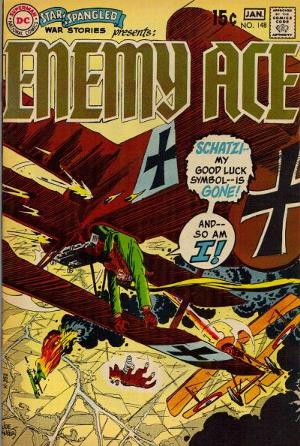
“The Enemy Ace Archives: Volume 2” is another top-notch comics take on death in the skies–and angst on the ground–during World War I. Writer Robert Kanigher has a memorable character in his titular “enemy ace,” a noble German pilot named, Hans von Hammer, aka “the Hammer of Hell.” He’s one of the top aces on any airfield, but his skill in the skies only wreathes him in death, both of the men he’s shot down and the green pilots who fail to come back from the missions he leads.

Von Hammer sees his dogfights through a gentlemanly lens, allowing duels to proceed without intervention and letting his foes escape when their guns run out of ammo. At the same ties, he knows the skies are fickle and is sure that it’s only a matter of time before death claims him as well.

Artist Joe Kubert (along with some fill ins) does an excellent job of capturing the planes in flight as well as in their final, flaming moments. The action is clear and exciting, and von Hammer’s anguished facial expressions are captured well without veering into parody.

In many ways, “Enemy Ace” is one heck of a anti-war comic, portraying both the futility of all these deaths and von Hammer’s pretensions about honor in combat. The stories here are ambitious, capturing everything from a wounded escape across enemy lines to an amoral commanding officer who could have come straight from “Paths of Glory.”

To be clear, this is still the Silver Age, so we have enemy pilots dressed as hangmen and skeletons and even, improbably, St. George. But even puppies aren’t safe in this installment, as one famous cover shows, and the creators have much more to share than just the thrills of weird combat.

Fair warning: Don't go into this issue expecting a miracle.
Fair warning: Don’t go into this issue expecting a miracle.

Review: God Knows by Joseph Heller

GodKnows

A repetitive, demanding and thoroughly amazing novel from the creator of “Catch 22.” “God Knows” tells the story of the Biblical King David in his own voice, as the fabled Goliath-slayer remembers his life and its complication on his deathbed. As he nears the end, David can’t help but retrace his life in his mind, returning again and again to certain formative events: the murderous rage of the previous King, Saul, David’s still-steaming lust for wife Bathsheba and the rebellion and death of his son, Absalom.

It’s natural for David’s mind to retrace these formative moments, the ones that brought him to his throne and also delivered such heartbreak. But it can make for slow reading, especially at the beginning of the book, when David’s musings are untethered from the story that brought him to his current royal, debilitated state.

It’s only as the story builds that we move from his decline to his rise: playing the lyre for Saul, slaying Goliath, becoming a hero and then running from the king that sees him as a threat. We move through banditry, rebellion, the pains and pleasures of many wives, and the hard politics of managing a ruling coalition. There’s also his lust for Bathsheba, which leads David to send her husband to his death in battle, a sin that ends the communion he previously had with the Lord.

“Did I kill Uriah to avoid a scandal or because I already had settled in my soul that I wanted his wife?” he wonders. “God knows. For not only is the heart deceitful in all things, it is also desperately wicked. Even mine. This danger in being a king is that after a while you begin to believe you really are one.”

Heller’s David is a fully human creation, both sharp and sentimental, despairing and proud, always ready with a joke or a bit of vulgarity. See him reflect on his showdown with Goliath, “I knew I was good. I knew I was brash. I knew I was brave. And with Goliath that day, I knew that if I could get within twenty-five paces of the big son of a bitch, I could sling a stone the size of a pig’s knuckle down his throat with enough velocity to penetrate the back of his neck and kill him, and I also knew something else: I knew if I was wrong about that, I could turn and run like a motherfucker and dodge my way back up the hill to safety without much risk from anyone chasing me in all that armor.”

The action is centered in the Middle East in Biblical times, but David’s voice speaks outside the frame, referring to his statue by Michelangelo (he’s not a fan), telegraphs, the Babylonians and all the uneasy history to follow. He’s savvy and smart, a contrast to his son Solomon, who’s humorously portrayed here as an oaf who poaches all his best lines from David.

The title itself is a clever one. On one hand, it sums up the uncertainty of human lives–who knows why God does anything? But on the other, it outlines David’s real gripes with the Lord: the king refuses to speak to him anymore, put off forever by the death of his infant son with Bathsheba, who was killed by God as punishment for the adultery and murder that forged their relationship.

Heller does an amazing job veering from Mel Brooks-level humor to palpable pain and pathos, often on the same page. David is tired of living, but he’s not tired of reliving his life in his own head, wondering about the events that shaped him and planning revenge for the slights he’s endured. Tonally, the book reminded me of John Barth’s “The Sot-Weed Factor,” another irreverent take on a historic subject. “God Knows” has a world-class author committing himself to a singular voice all the way through a moving ending. It takes a while to grab you, but after a certain point it’s a pleasure just to follow along.