Category Archives: Uncategorized

Book Review: “The Lincoln Highway” by Amor Towles

Cover: The Lincoln Highway by Amor Towles

A Midwest, mid-century, American coming-of-age epic, “The Lincoln Highway” takes to highways, railways and even an ill-fated boat to explore the shifting poles of loyalty, responsibility, and justice.

We follow several protagonists on this engrossing journey, but our first is Emmett. A native Nebraskan, he begins our novel returning home after a stint in juvie. He was serving for a crime that was more an accident–shades of Tom Joad–and he’s ready to move on to a fresh beginning, especially with his father dead, his family farm foreclosed on, and his little brother in his custody.

Complications ensue, though, when a couple former cellmates join his early parole…despite the fact that they haven’t quite finished their sentences. They’re Duchess, a wise guy with a detestable con-artist dad, and Woolly, a dreamy rich kid from New York who spends his days zonked out on little bottles of “medicine.”

Emmett wants to take his brother out West to California for a fresh start restoring houses. But Duchess and Woolly have their eyes on Woolly’s inheritance out east, locked up in his great-grandfather’s safe. The group embarks together, then diverges, with most of the novel covering their struggle to meet back up to settle old business. Along the way there are hobo camps and burlesque circuses, orphans lavished with strawberry preserves and fantastical compendiums of heroes of old.

Author Amor Towles has a propulsive effect, carefully structuring his reversals and twists. He also has a compelling, half-folksy style, blending his near-mythical exploits with a kind of homespun wisdom, like a Homer of the highway.

His characters are memorable and well-voiced. Beyond that, though, he uses his dynamic cast to explore larger issues of character. What’s the boundary between a hothead/trickster/screw-up and a menace? Can everyone be redeemed? Or are some people just too lost, even if it’s due to circumstances beyond their control?

In wrestling with these issues, “The Lincoln Highway’s” energetic pace and smooth tone can work against it. Towles can gloss over the messiness of his characters with another cliffhanger or some new dramatic entrance. But to his credit, his keeps the messiness present, leaving it for the reader to work on, all the way to the novel’s divisive ending. (I found the finale too convoluted and not in keeping with the characterization shown to that point, but I enjoyed the journey to get there.)

Quotes

“For no matter how much chance has played a role, when by your hands you have brought another man’s time on earth to its end, to prove to the Almighty that you are worthy of his mercy, that shouldn’t take any less than the rest of your life.”

“Standing there before his grandfather’s clock listening to his brother-in-law, it suddenly occurred to Woolly that maybe, just maybe, St. George’s and St. Mark’s and St. Paul’s organized every day to be an every-day day not because it made things easier to manage, but because it was the best possible means by which to prepare the fine young men in their care to catch the 6:42 so that they would always be on time for their meetings at 8:00.”

“As the old gent shuffled his way to the bureau, I scanned the room, curious as to his weakness. At the Sunshine Hotel, for every room there was weakness, and for every weakness an artifact bearing witness. Like an empty bottle that has rolled under the bed, or a feathered deck of cards on the nightstand, or a bright pink kimono on a hook. Some evidence of that one desire so delectable, so insatiable that it overshadowed all others, eclipsing even the desires for a home, a family, or a sense of human dignity.”

Book Review: “Rushes” by John Rechy

Book Cover: "Rushes" a Novel by John Rechy

Set in one long night in a gay bar in 1970s California, John Rechy’s “Rushes” explores the cruising scene of that era. Explicitly sexual, it conjures the internal lives of its characters, channeling how it feels to be on the “sexhunt” in a dim bar centered solely on that purpose.

We meet a core group of friends/competitors. Endore, the authorial stand-in, is older but still attractive, obviously drawn to the sex and scene of the Rushes but wary of it as well, ambivalent about its self-loathing and superficiality. Chas is an unapologetic leatherman, a top man into sadomasochism. Bill is a young beauty who, we later finds out, likes to dominate through submission. And Don is too old and unattractive to make the scene anymore, but he still gets in with his friends, tormenting himself with all the men he can’t have.

The book takes us through a long night in the steamy bar, placing us in the mind of different characters as they reflect on the scene, their lust, their angst and limitations. The narrative can feel too internal at times, occasionally losing momentum as characters fixate on repeating themes and memories. Inciting incidents gradually introduce new complications, though. A woman ventures into the bar–a cruel, slumming, artistic fashion designer looking for stimulation. Two prostitutes find refuge there and are forced away. A young gay man enters on his first night out, and a self-loathing male prostitute outdoors rages against his clientele.

Throughout these scenes, Rechy shares what it’s like to be on the hunt. His characters are constantly checking out one another, scrutinizing fresh faces that enter the bar, signaling to test connections but not committing for fear of being rejected and shamed. The docks are nearby, and meat trucks too, after-hours destinations for anonymous sex. Danger lurks as well, as gangs of gay bashers cruise the streets, looking to attack and even kill gay men. Some might even enter the bars themselves to lure their prey outside.

With “Rushes,” Rechy seems to critique different movements in the gay scene at the time of publication. Endore seems skeptical of the leather fetishists and their associated humiliations, arguing that S&M is more an internalization of self-loathing than an embrace of gay men’s outlaw status. But he’s skeptical of monogamy among gay men too and criticizes the misogyny that erupts in their spaces, even as he admits he resents women venturing into the Rushes.

A successful lawyer but a failed cruiser, Don argues for the pre-Stonewall era as a more civilized time, the police raids balanced by better manners, a sense of class. But he’s obviously crumbling, falling into drunkenness, loneliness, irrelevance.

Each character is a cautionary tale, and the Rushes itself isn’t enticing. It’s scuzzy and desperate. A late-night descent into the S&M club next door, the Rack, is even more hellish. But Rechy captures that each place is alive with something beautiful, something that can’t be grasped by straight society. As Chas argues, “When you’re still walking the piers, a faggot all alone looking for sex, and it’s Sunday morning, you know you’re alive, man. Alive. Because you know you’ve been through the greatest adventure.”

The book itself attempts to weave that spell, to capture precisely the allure of the Rushes. In doing so, it conjures something almost like a bacchanalia, full of derangement and frenzy and even sacrifice. Endore and his crew seem both blessed and damned; Rechy does a great job sharing both aspects of their experience. From a historic standpoint, though, it’s hard to finish the book and not shiver at what would be coming for these characters next, as the 80s dawned and the AIDS epidemic erupted. But that’s not here. Not tonight.

Quotes

“As often as he comes to the Rushes, Don still feels an outsider in it, and is. In the homosexual world of the bars there are avenging ghosts who refuse exorcism: the relentlessly effeminate among the relentlessly–even when unsuccessfully–macho men; the faded “beauties” changing into “queens” and clinging to shadows and the shadow of memories; and the older men–often near-alcoholics–who refuse to disappear from the sexual arenas or to surrender to the tight dinner groupings of men their age and older, gatherings brightened or rendered event more desolating by an occasional, quite often discreetly bought, “boy.”

Don is one of the avengers.


“Have you chosen yet whom you will be pursued by, Endore?” Martin stabs.

Rage bursts. “When will you finally choose, Martin?”

“I choose not to choose,” Martin answers. “There is no greater power over the beautiful than to withhold desire from them.”


“Listen,” Chas says passionately. “Listen. When you’re still walking the piers, a faggot all alone looking for sex, and it’s Sunday morning, you know you’re alive, man. Alive. Because you know you’ve been through the greatest adventure. And you’re alive. Still alive! Despite the punks and all the yells of ‘Queer!” and all the raids–despite all their shit, the shit we live with, we’re alive! That’s the only victory we have, man, and that’s what makes being a faggot special. That you can survive all that–for an excitement like no other, and you’re always on the edge, and that’s when you’re most alive, when you know you’re still alive, and tomorrow, too, because tomorrow it all starts again, our only continuity. That’s the joy that only we faggots have. Because in between the busts and the headbashings and the screams for our blood–before whatever it is that finally takes us over–getting drunk or going crazy or, yeah, killing ourselves or just dying–we’re alive, and they can’t even feel, not even pain, but we do, pain and relief when it’s over, and you call it S & M and that’s ok. But we feel, and they’re dead–having to come here to sniff at our world, breathe our sweat.”

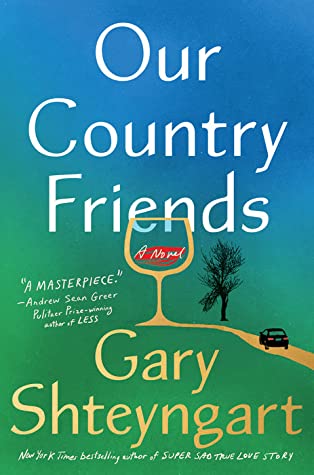
Review: “Our Country Friends” by Gary Shteyngart

Intense, funny and charged with the nervous fear of the early days of the COVID-19 pandemic, Gary Shteyngart’s “Our Country Friends” blends a classic “country estate” novel with our all-to-familiar dystopian present.

As the novel begins, writer Sasha Senderovsky (a bit of a Shteyngart fill-in) invites a group of old friends to stay at the country house he shares with his therapist wife and their adopted daughter. There’s a main house and a series of little bungalows, surrounded by dying trees and sharing creaky plumbing, problems that Sasha doesn’t have the money to fix.

Our host is past his prime earning potential and hoping for a TV script to come through. This long-delayed project brings a bonus guest to the estate: a famous actor, unnamed, who is developing the script with Sasha. This partnership leaves Sasha beholden to the actor’s good will, even as the confined star stirs up the already tense “pandemic meets ‘Trump-country'” environment.

Sasha and his friend are decidedly not Trumpers. They are mostly immigrants, high school friends from New York City who’ve seen a range of success. A failed adjunct professor/grease monkey at his uncle’s restaurant is still hung up on his high school crush, who’s recently hit it big as the tech guru behind the “Tröö Emotions” app. There’s also a trust fund bon vivant and a former student of Sasha’s who grew up poor, rural and white and isn’t above stirring up culture-war resentments for publicity.

It’s a good cast, each distinct, prickly and lovable at the same time. They drink too much and fall into cliques (as well as in and out of one another’s beds). They tend toward the libertine, with outdoor sex and plenty of skinny dipping in the pool.

They also occupy an elevated social class, even if some of them, like Sasha, are doing so on credit. (He winces at a four-figure liquor tab but still signs the check.) Indeed, one of the book’s rare missteps is when Sasha’s student, Dee, obliviously reveals just how well-padded her bank account is. It’s an unlikely gaffe for someone who is supposed to have grown up counting every penny.

There are plot engines–an app that bewitches one of the guests, a social media scandal, a black truck that periodically sits outside the gates. And there’s the great ghost of COVID looming over everything, haunting our guests as they seek refuge from the dirty world outside.

Shteyngart captures the uncertainty of the early days of the pandemic, the hollow gestures of hygiene theater, the understandable paranoia and the countervailing desire to get drunk and hug your oldest friends around the neck. That said, “Our Country Friends” transcends the pandemic, addressing larger issues of friendship and success, betrayal and heartbreak. I thought it lingered too long in its final fadeout (like COVID itself, I suppose), but it was still a warm and rewarding read.

Quotes

“At their lower moments, they always overcame their parents’ programming, always offered each other more than they had ever been given.”

***

“She remembered the little fishes her father had used to bait the sea bass of Long Island Sound, the way they used to thrash on the hook, unsuitable for anything but dying between the teeth of a more important animal.”

***

“People were dying in the city. Some more than others. The virus had roamed the earth but had chosen to settle down there, just as the parents of Masha, Senderovsky, Karen, and Vinod had chosen it four decades ago as a place to escape the nighttime reverberations of Stalin and Hitler, of partition, of the pain that radiated not to distant memory but cracked outright from their own fathers’ hands.”

***

“Senderovsky watched his wife in the sundress return to her patients and her child’s lesson plans and thought of the raft of mystery that floats between two partners, even contented ones, as they turn in for the night. He wished he could fall in love with someone as his wife evidently had done. He had chased after beauty for such a long part of his life, until he had caught up with it and found it, like everything else, worthy of no more than a chapter or two of heightened prose.”

Book Review: “Tunnels” by Rutu Modan

Israeli comics creator Rutu Modan assembles a lively fictional cast for “Tunnels,” which sees a crew of oddballs conducting a DIY search for the Ark of the Covenant.

The story is sparked by a clue discovered on an old cuneiform tablet. The excavation is led by Nili, a single mother and former archaeology wunderkind who’s trying to settle some old family business. It’s funded by an antiquities collector who’s not very particular about where his treasures originate. (ISIS is on speed dial.)

A crew of Orthodox “settlers” provide the muscle for the dig, motivated by faith/political concerns. There’s also a dastardly professor who screwed Nili’s dad out of tenure, some Palestinian colleagues from a long-ago field season and even a couple knuckleheads who claim they’re with ISIS, although it seems like they can barely tie their shoes.

Modan follows the excavation as it tunnels into Palestinian territory, bringing her cast together to squabble and scheme. The art is colorful and evocative, like something Herge might draw, although not so neat. Her figures tend to be a bit squat and ugly, but they have plenty of personality.

Modan’s best work is done juggling the voices of her cast. She captures the little details that distinguish each group, all while maintaining enough individuality so that no one comes off like a cliche. The plotting tends toward the zany, but it’s clever and fun and offers surprises all the way up to the end. Modan also doesn’t shy away from the political subtext of life in Israel, both contemporary and Biblical, but her ultimate message is individualistic and deeply human.

“Tunnels” doesn’t wrap neatly. Instead, it offers something more ambiguous, winking out with a bit of dark humor that would be happily at home in a Coen Brothers film. It’s creative and memorable, a real accomplishment.

Book Review: “Picture This” by Joseph Heller

In “Picture This,” Joseph Heller uses Rembrandt’s portrait of Aristotle with a bust of Homer as a device to analyze avarice and empire, traveling from ancient Athens to mercantile Amsterdam all the way into the present day. In his trademark style, Heller uses repetitive, layered storytelling–much as a painter uses brushstrokes–to illustrate his central theme: that power is derived from cruelty.

There isn’t much of a narrative to advance this thesis. We do get scenes of Rembrandt in his workshop, applying and removing paint as he ponders how to dodge his creditors. But much of what Heller offers is synopsis, selections from the Greek classics: the trial of Socrates, the plague of Athens, the siege of Melos. He uses these pieces of history, like a lawyer building a case, to argue for the essential futility of the human condition. Warmongers profit, Heller tells us. Innocent people are massacred, enslaved, exploitatively forced to toil. Thus it ever was, and thus it ever will be.

In sketching this pattern, though, Heller finds himself drawn to the outliers. Take Rembrandt, for instance. The painter is a crude man. He squanders his childrens’ inheritances, impregnates his housemaids, takes on debts he’ll never repay. He stitches old canvases together to try to make a buck from frustrated patrons. And yet he is exquisite in conjuring the gilt of gold or using a few brushstrokes to evoke the contours of lace.

There is something inexplicable about Rembrandt, a bit of the divine, even if he never benefits from it. Instead, he dies bankrupt while his paintings appreciate in the hands of counts and wealthy widows.

Socrates too is unique. The philosopher opts out of the striving and cruelty of his ancient home; he walks away from a dictator’s orders, accumulates nothing, has his wife dump a chamber pot on his head. Put on trial for blasphemy and corrupting the youth, he defends himself, arguing that he deserves a pension from the state for his work. He refuses compromise, contrition, escape and exile, sticking to his principles…that and a large glass of hemlock.

It’s worth noting, as Heller does, that Socrates risked his life for Athens, taking up arms multiple times as a common soldier on the city’s behalf. These actions were pointless–everything seems pointless to Socrates, at least in Heller’s telling–but he did it anyway. One has to serve the empire one is born into, Socrates suggests. In this service, it’s easy to see a parallel to John Yossarian in “Catch 22” and Heller’s own combat experience in World War II.

Like most of Heller’s books, “Picture This” argues that the world is senseless and arbitrary and often cruel. In transmuting history into fiction, it also argues that history isn’t really knowable. Many of the paintings credited to Rembrandt are forgeries. Socrates’ words are passed down to us through Plato, who was only a child when many of them were uttered.

And so like Socrates, Heller makes a show of flaunting his ignorance, highlighting what he doesn’t know–what can’t be known. We never learn anything from history it seems. Only that the same dark patterns keep recurring.

Quotes


“Nowhere in history is this assumption that human life has a value borne out by human events.

All our religions but the Judaic and the Greek think more of us dead than alive.”

***

“Rich is the country that has plenty of poor. In periods when prosperity is general, the value of the impoverished to that country increases, and nations not rich in poor must import indigents from inferior countries for the labor now considered degrading for citizens of repute to perform.

The bidding sometimes goes high.

It is fortunate for the progress of civilization that there are always plenty of poor.”

***

“War is always in fashion, my dear old friend. Look at our history. In our golden age of Athens there is scarcely a period as long as five years in which we have not been at war. We lost most of the big battles and can’t hold on to what we win. Yet the city prospers, the economy booms. And now see how unconvincing and feeble poor Nicias appears each time he comes into public to argue for threadbare, ragged, tedious peace. A politician can roar for war. For peace he can only plead.”