Category Archives: Uncategorized

Book Review: “Check, Please Book 1” by Ngozi Ukazu

A cute, cartoony, coming-of-age saga, “Check, Please” features Eric “Bitty” Bittle, a short, former figure skater who heads up to Massachusetts to play hockey at fictional Samwell University. Bitty’s good on the ice, but he didn’t grow up playing hockey, so he faints when faced with the contact that’s inherent to the sport. This leads to some early conflict with the team and its brooding captain, Jack Zimmerman. But it also offers an opportunity for growth, especially once Jack shows his kind side by taking the freshman player under his wing.

Bitty is gay and excited to express himself after growing up in a conservative southern town, where his father (who pointedly doesn’t make an appearance) was the tough high-school football coach. He eventually comes out to his teammates, who are supportive and welcoming.

Indeed, creator Ngozi Ukazu does an excellent job capturing the camaraderie of the squad. From practices to games to blow-out keggers at their hockey “haus,” the team is lively and fun. It’s easy to distinguish the characters, even if most of them have the good-natured “loving life” vibe that Bitty puts off.

Indeed, if I have a critique of the book, it would be that that it’s almost too pleasant. There’s conflict here and there, and Jack’s competitiveness and wounded backstory provide a nice contrast to Bitty’s constant cheer. But it can verge into cutesy in the same way that Scott Pilgrim or Ryan North’s “Squirrel Girl” series can. These are all books that I enjoy, but they presume a level of good will and “everything will work out if we just talk to one another” attitude that verges on utopian to my tastes.

Still, the cast for “Check, Please” is awfully cute, and Ukazu does a great job with the writing and the illustrations. Her characters are distinct, dynamic and capable of delivering a full range of emotions with just their faces and gestures. If you like cheerful coming-of-age stories, this a great comic to check out.
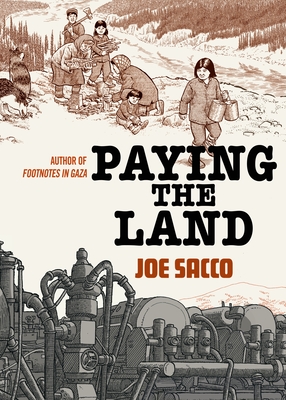
Book Review: “Paying the Land” by Joe Sacco

Cover of Joe Sacco's "Paying the Land"
In this fascinating, immaculately illustrated graphic novel, cartoonist Joe Sacco travels north to Canada’s Northwest Territories to spend time with the Dene people who are native to the region. He introduces us to a broad cast of characters who walk us through the region’s history, highlighting the difference between traditional and industrial ways of life.

Paying the Land” spends time with snowmobiles and moose-skin boats, dog-sleds and salmon camps, winter roads and resource extraction. It also delves into politics, both the politics of exploitation that left the Dene people dispossessed as well as later movements that saw them working together (or at odds, in some cases) to reclaim their autonomy.

One of the book’s saddest topics is the Canadian government’s former policy of forcing Dene children into abusive residential schools that worked to eradicate their language, culture and family ties. Sacco’s interviews reveal how this policy, which affected many still living, continues to fracture families and communities today.

Sacco gives this trauma the space it deserves, exploring the alcoholism, abuse and suicides resulting from this devastation. At the same time, he also shares moments of joy and solidarity. A man shares his journey to sobriety and what it means to be a positive example for his son. A young adult reflects on the connection that a successful caribou hunt establishes with his ancestors. The book ends with a whole gymnasium playing the “hand game,” erupting into a kind of euphoria as one man beats the odds over and over again.

We remember these moments in part because Sacco is so successful in capturing the diversity of the people he meets up north. His interviews and his carefully rendered illustrations establish his characters as individuals–sometimes at odds with one another, but always memorable and distinct. It’s a great accomplishment.

Book Review: “Let’s Go (So We Can Get Back)” by Jeff Tweedy

Cover: Jeff Tweedy, "Let's Go (So We Can Get Back)"

An excellent artifact for Wilco fans, “Let’s Go (So We Can Get Back)” is likely also a worthwhile read for anyone interested in a firsthand look at the music industry as it moved from the label/A&R days into streaming and beyond.

Singer and songwriter Jeff Tweedy walks us through his life, taking us from a rundown, if relatively secure, childhood in Belleville, Illinois to his more elevated experiences playing around in the Wilco loft and making records with his kids. Throughout, he is approachable, candid and often funny.

A good portion of the book is dedicated to the Jays in his life. Jay Farrar, his band co-leader with Uncle Tupelo, is portrayed as distant and withholding, while Jay Bennett, his sparkling Wilco sideman, comes across as warm and addicted (if sometimes scheming).

Tweedy doesn’t shy away from his own addiction and rehab, but his songs are the book’s primary focus. Tweedy admits he isn’t the best singer or guitar player (although I enjoy him in those capacities), but he is an excellent songwriter, prolific, evocative and adaptable. He shares his working method, the core of which seems to be simple, sustained effort.

Tweedy also speaks at length about the anxiety that underlies his mellow public persona, a family trait that seems linked to a tendency to self-medicate. He is game throughout, reliable and generally funny, if prone to a few clunkers in that regard.

Given everything he’s accomplished, though, it’s easy to suspect that he has to be a bit more ambitious than he lets on. The tone in the book is a bit, “aw shucks, it all just happened.” It’s hard to believe it was quite that simple.

But Tweedy shares some real wisdom too, particularly when he reflects that while a band may be important, it’s a temporary arrangement at best, not a blood pact to be preserved at all costs. In one of the blunter moments of the book, Tweedy reflects that he kicked Jay Bennett out of Wilco because he was afraid he was going to die otherwise. It rings true, as does much of his memoir.

Quotes

“When my dad died we put together a playlist of all of ‘his’ songs to play at the funeral home before and after the service. My sons, Spencer and Sammy, fell in love with “Southern Nights” in particular, so after the funeral we drove back to Chicago listening to Glen Campbell in the car. It was beautiful to hear that song through their ears and feel it being liberated from its past, transforming into something with powerful personal meaning for all of us. We just opened the windows and let it blare. And then we got home and learned that Glen Campbell had died. I’m pretty sure we killed Glen Campbell.”

“The look on Jay’s face was tragic. I felt bad for him. This was not a serious vehicle. I’m not sure how we talked him into climbing aboard, and once we did, I have no idea how we got him to stay, because the interior was even worse. White leather, mirrored ceilings, and a purple neon sign in the back lounge informing everyone, in cursive, that they were aboard the ‘Ghost Rider’ lest they forget. So we embarked upon Uncle Tupelo’s last tour learning how to sleep while being shot at eighty miles per hour down the highway inside a metal box that looked like the VIP room at a strip club and made us all feel like we were living inside a cocaine straw.”

Book Review: Seinfeldia by Jennifer Keishin Armstrong

Author Jennifer Keishin Armstrong offers a nice inside view into Seinfeld’s origins and impact, taking the series from Jerry Seinfeld and Larry David getting to know one another in New York City’s comedy scene all the way through minor-league baseball “Seinfeld” nights and “Soup Nazi” publicity tours.

The book is at its strongest at the series’ genesis, highlighting the co-creators’ ambivalence toward sitcom tropes and traditional measures of success as well as the series’ unusual creative freedom and climb to success. It’s fun to see the cast fall into place and meet the writers who shaped some of Seinfeld’s most memorable episodes.

Structurally, the book feels a little scattered–the chronology seems to double over itself a few times, and not enough time is spend exploring the series at its peak. Armstrong does a good job not just compiling plots and top lines from the series. Still, it would have been nice to focus more on the core of “Seinfeld’s” success and less on cultural phenomenon/career launchpad it became.