Book Review: “A Visit from the Goon Squad” by Jennifer Egan

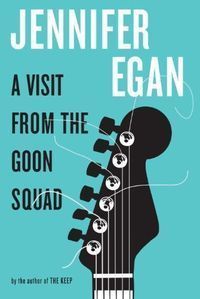
Illustration of guitar top with messy strings. Text: Jennifer Egan, A Visit from the Goon Squad

“A Visit from the Goon Squad” offers an impressionistic look at life in music. Jennifer Egan’s novel jumps from character to character in thinly linked scenes intended to illustrate the triumphs, compromises and, most frequently, failures that accompany the ego-driven impulse of trying to make yourself heard.

Gripping and beautiful written, it shares more sadness than thrills. Our recurring characters include a kleptomaniac with a damaged past who serves as an assistant for a punk rocker turned label mogul. His mentor drifts in from decades back, showing the predatory nature of the scene and the raw atavistic impulse to dominate. We get burnouts and broken writers, despot publicists and stay-at-home dads trying to recollect who they once were. 

It’s not seamless, but it’s tender and deeply felt. Egan absolutely nails the ending too.

Quotes

“She could tell that he was in excellent shape, not from going to the gym but from being young enough that his body was still imprinted with whatever sports he’d played in high school and college. Sasha, who was thirty-five, had passed that point.”

***

“In fact the whole apartment, which six years ago had seemed like a way station to some better place, had ended up solidifying around Sasha, gathering mass and weight, until she felt both mired in it and lucky to have it–as if she not only couldn’t move on but didn’t want to.”

***

“Lou is one of those men whose restless charm has generated a contrail of personal upheaval that is practically visible behind him: two failed marriages and two more kids back home in L.A. who were too young to bring on this three-week safari.”

***

“I looked down at the city. Its extravagance felt wasteful, like gushing oil or some other precious thing Bennie was hoarding for himself, using it up so no one else could get any. I thought: if I had a view like this to look down on every day, I would have the energy and inspiration to conquer the world. The trouble is, when you most need such a view, no one gives it to you.”

Book Review: “Hakim’s Odyssey Book Two–From Turkey to Greece” by Fabien Toulme

Cover: Hakim's Odyssey Book Two--From Turkey to Greece

French cartoonist Fabien Toulme continues his thoughtful, moving recollection of a Syrian refugee’s complicated journey to France. 

As this second volume starts, Hakim, his new and now pregnant wife, Najmeh, and Najmeh’s family have just moved from a smaller town in Turkey to Instanbul in search of more opportunities. But working under the table is hard in the big city too, particularly as more refugees make their way to the scene. 

So Najmeh’s dad buys a fake passport to make his way to France, bringing his family in soon after to begin the process of applying for refugee status. There’s one issue, though: Hakim and his new son, Hadi, aren’t covered on the family’s status, and so they have to stay behind. 

It’s a stressful, tenuous time, especially since Hakim is forced into sole caregiver responsibility as opportunities to earn money dwindle. Toulme does a great job recounting Hakim’s desperation as he’s forced to bunker down with his son in a hot-plate apartment, his wife mostly reduced to a weeping voice on the phone. 

Things get worse when tragedy strikes back home in Syria, leaving Hakim nearly broken. As he tries to rebound, a paperwork snafu with the French consulate leaves him open to a choice he’s previously dismissed as too risky: making a trip across the Mediterranean with Hadi in search of safe refuge in Europe.

These scenes are the most heartrending in the book. They cover the nervy work of trying to find passage, the preparations for a dangerous journey, the hours of waiting on a remote beach under the watch of armed men. Hakim has prepped as best he can, buying a life jacket for himself and, devastatingly, water wings and a tiny tube for little Hadi. But the journey becomes desperate, with the men jumping into the water to try to swim their raft to shore in the middle of a dark, strange sea. 

Toulme conveys just how frightening it is–how worried Hakim is for his son, and how desperate he’s become to take this risk. Since the series opens with Hakim and Hadi healthy in France, we know they make it, thankfully. But this second book of Hakim’s Odyssey fulfills Toulme’s goal of humanizing the refugees risking their lives to travel to Europe.

Book Review: Nettle and Bone by T. Kingfisher

Cover: Nettle and Bone by T. Kingfisher. The book shows a woman in a rough-hewn garment.

Charming and bingeable, T. Kingfisher’s “Nettle and Bone” blends a thrilling sense of magic with some predictable storytelling.

The book stars Marra, a not very princess-y princess from a tiny kingdom stuck between two larger rivals. An alliance is what’s needed to keep her people safe, and so her mother arranges marriages for her older sisters with the heir of the Northern Kingdom. Marra is set aside in a convent, both to prevent her from producing any pesky rivals to the throne and also to keep her as a spare spouse in case another wife is needed.

Sadly, a spare has been needed before. It turns out Prince Vorling, the heir to the northern kingdom, is a violent man, with his wives bearing the brunt of his anger. When Marra realizes the seriousness of the situation, she decides that the only recourse is for him to die, and so she sets out on a quest to find the magical support she needs for a bit of regicide.

“Nettle and Bone” hits it strides when it embarks on its “Goodbye Earl” phase, but the book spends too much set-up getting there. It hits us with more backstory than necessary, with some convoluted chronology thrown in to boot.

Still, Kingfisher’s world-building is my favorite part of this Hugo-award winning tale. We get dust wives and fairy forts, bone dogs and goblin markets. There are fey folk that can make your teeth dance away from your jawline and great rolling curses gathering grave robbers like gelatinous cubes. It’s imaginative, creative and often surprising; I loved the way she twisted some familiar fantasy tropes and would recommend the book on those merits alone.

On the flip side, the characters aren’t very nuanced. They’re spirited and well-rendered, but they’re generally one note, hero or villain, with few complications to color them. It’s exciting how Marra gathers her diverse crew, but they go along with her a little too easily. That’s especially true for the book’s romance, which feels painfully obvious as it predictably progresses.

So it’s a mixed bag. The creativity certainly recommends it, particularly since it’s a compact and easy read. But I do wish it had risked more, even if I enjoyed how it all turned out.

Book Review: “Harlem Shuffle” by Colson Whitehead

Book Cover: Harlem Shuffle by Colson Whitehead

An immersive novel with equal footings in voice and plot, “Harlem Shuffle” introduces us to the half-con world of Ray Carney in three segments covering 1959 to 1964.

Carney owns a furniture store in Harlem; his name is right above the window for anyone looking to find him, we’re often reminded. As the book begins, he’s still struggling to cover the rent and provide for his pregnant wife, Elizabeth, and their daughter, May.

He mostly plays things straight at the store, but he’s not above taking the odd piece of “lightly used” merchandise and placing it on the storeroom floor. He is the son of Bike Mike Carney, after all, a thug whose name still resonates years after Big Mike’s death by cop. Ray is haunted by his neglected childhood, but he knows there’s money to be made on the other side of the law. He needs it if he wants to get his family out of their scruffy apartment right over the train.

Ray gets in deeper than he intends, though, when his impulsive cousin Freddie mentions his name to help a crew clear some hot merchandise. And from there, Colson Whitehead engagingly explores the blurred lines between the crooked world and the straight, between Ray reading the literature on the latest lines of Arkesta recliners and the man installing a secret door for his after-hours business.

The narrative is gripping and tight. We flow through a series of scenes, through single-room occupancies and ritzy all-black social clubs as Ray tries to navigate both sides of his business. And business it is. Ray’s a classy guy, a family man. He mostly tries to stay on the up and up. But he can’t help but sink in a little deeper, especially where his cousin Freddie is involved.

As anyone who’s read “The Underground Railroad” knows, Whitehead is a beautiful writer. The lines here are evocative, blending metaphor and broken windows. Sometimes the writing can get a little too rich–you might have to reread a branching sentence when you just want to get through a scene–but on the whole it’s a pleasure.

The story is strong too. Ray is a complex figure, a man of secrets. My only complain is that the book’s resolution comes too easily, with a tidiness that seems unearned. The book sets up a real mess, and while part of me was glad Whitehead didn’t see it through, I couldn’t help but feel teased. But I’m glad to see he’s written a sequel, “Crook Manifesto,” as I’m eager to dive back into Ray’s world.

Quotes

“The husband shrank from the merchandise when he came too close to it, as if proximity plucked money out of his pockets. Carney remembered those days, everything too dear and too necessary at the same time, just him and Elizabeth making their way in the world as newlyweds.”

***

“You hear people say, ‘Oh, when our boy came back from the war, he was <i>changed</i>. The war didn’t change Pepper, it completed him.”

***

“In the end, he didn’t have to go into a big pitch at all. What you want in his trade, that most perfect thing, is a product that sells itself, an item of such craft and novelty that it renders the salesman superfluous. He had barely begun his spiel when it was clear that Fucking Over Duke, it turned out, sold itself.”