Category Archives: Uncategorized

Book Review: “But You Seemed So Happy” by Kimberly Harrington

In “But You Seemed So Happy: A Marriage in Pieces and Bits,” writer Kimberly Harrington explores the voluntary dissolution of her marriage with dark humor and brutal honesty. On the balance, though, the book tends more toward the latter, making for an uneven, unhappy read.

As Harrington admits in the introduction, this book about her divorce didn’t have a great inciting incident. There wasn’t infidelity or scandal; thankfully, there’s no abuse or deep betrayal. Instead, the slow fadeout of her marriage falls into the classic category of “irreconcilable differences,” and she spends these pages trying to examine just how they got to that point.

The memoir walks us through the romance-adjacent portions of Harrington’s life: her parents’ divorce, her high school longing, a move to Portland, meeting her husband, getting married, moving into a dilapidated farmhouse and having kids. From there, it becomes a slow, steady fizzle, a marriage drained of its love like a soda going flat.

As a life path, it feels common enough. And while the author is adept at expressing her frustration–with her marriage, with her husband, with the patriarchy–it doesn’t seem like she fully lands the larger point she’s trying to make. On the whole, Harrington is skeptical about marriage. She argues, fairly, that there shouldn’t be anything shameful or embarrassing about a several-decade relationship coming to an end. She even has a chapter, “Things People Say When You Get Divorced That They Really Should Say When You Get Engaged.” But despite her best efforts to avoid off coming off as “the divorce witch,” her tone feels more personally aggrieved than anything. She sounds bitter.

Part of the issue is that we’re getting a one-sided account of the relationship. Her husband is only present in her telling; he has his own perspective on all of this, one we only get glimpses of when he refers to her as “high strung” in a text she snoops on or takes issue with Harrington entering a Tinder flirtation during their separation without telling him. On the whole, though, he comes off as a good guy, decent and honest. Harrington gives him full credit for these positive traits, but the reader spends a lot of the book wondering where the problem is exactly.

Part of the challenge is that Harrington poses as a no-holds-barred truthteller, but she doesn’t seem to put herself under the same microscope that she applies to her husband and society. As she admits at one point, a point of contention for her husband is that she has “different rules” for herself. The book supports that. Harrington often comes off as aggressive and self-absorbed, too caught up in what others think. It seems she felt the need to write a book-length memoir about why she was justified in getting a divorce instead of just getting one. (Spoiler: at the end, the couple is separated but still married and living in the same house.)

Harrington certainly raises some thoughtful points, about her marriage and everyones’, and the bitter humor can be entertaining. But she’s better at expressing her frustration than diagnosing what’s going on. When she looks back at the past, her tone can be nostalgic and sweet, but when she writes about wanting to put a fist through a wall because of her husband’s chewing, it just feels rant-y.

On the deepest level, “But You Seemed So Happy” feels like a lament about how she was supposed to be a special, cynical, smart young thing and instead has to go through the same dumb aging and disappointments and making a living that everyone else does. Unfortunately (and granted, this is a dude saying this), it happens to the best of us.

Quotes

“I thought I didn’t care what he did and I would be happy for him when he moved on, because I was now an Evolved Person. Instead, I was shocked at how flashy and visceral my jealousy was. He could move on after I moved on! I’d be happy for him after I was happy with myself first!”
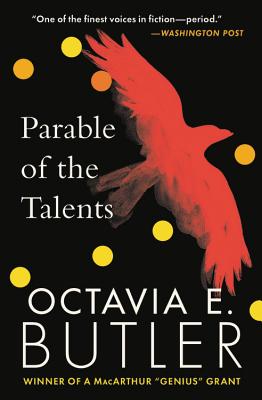
Book Review: “Parable of the Talents” by Octavia Butler

Octavia Butler’s dystopian “Parable” series reaches a powerful conclusion with “Parable of the Talents.” The book’s premise feels alarmingly familiar. It’s set in a nearly collapsed United States, one beset by climate change and rising religious fascism. Penniless migrants head north on foot to try to start new lives in Canada or Alaska, but they’re threatened the whole way by criminals and slavers.

Our lead character is Lauren Olamina, a young black woman who is a community leader and the founder of a new faith, Earthseed, that posits that God is Change and that humanity’s destiny is to work together to venture out into the stars. As “Parable of the Talents” starts, though, Lauren are her small community are stuck in decidedly earthly circumstances, living a “nineteenth century existence” in a community they’ve built on a patch of land in northern California.

Given all the trauma these characters have experienced–murder, kidnappings and worse–it seems like a safe haven. But then things go wrong. Few authors are better at having things go wrong than Butler. She’s a master of the sudden reversal, taking what seems to be a hard-won, uneasy peace and dropping it to peaces, like a porcelain plate.

I won’t go into details about how things go wrong–that would spoil the surprise–but scarily, the chain of events starts with a near-fascist U.S. Presidential candidate promising to “Make America Great Again.” Considering that Butler wrote her book in 1998, that’s a frightening bit of foresight.

“Parable of the Talents” is an easy page turner, and the author does a wonderful job conjuring the despair of the oppressed as well as enough twists and reversals to keep the story flying along. She also sets up a nicely complex structure, with multiple narrators and different perspectives, all converging for a surprising ending. A great piece of storytelling.

Quotes

“I have also read that the Pox was caused by accidentally coinciding climactic, economic, and sociological crises. It would be more honest to say that the Pox was caused by our own refusal to deal with obvious problems in those areas. We caused the problems: then we sat and watched as they grew into crises.”

“The human species is a kind of animal, of course. But we can do something no other animal species has ever had the option to do. We can choose. We can go on building and destroying until we either destroy ourselves or destroy the ability of our world to sustain us. Or we can make something more of ourselves. We can grow up. We can leave the nest. We can fulfill the Destiny, make homes for ourselves among the stars, and become some combination of what we want to become and whatever our new environments challenge us to become. Our new worlds will remake us as we remake them. And some of the new people who emerge from all this will develop new ways to cope. They’ll have to. That will break the old cycle, even if it’s only to begin a new one, a different one.”

Book Review: “Politics as Sound – The Washington, DC, Hardcore Scene, 1978-1983” by Shayna Maskell

Cover: "Politics as Sound - The Washington, DC, Hardcore Scene, 1978-1983"

Professor Shayna Maskell offers an engaging scholarly look at the origins of the DC hardcore scene with “Politics as Sound – The Washington, DC, Hardcore Scene, 1978-1983.” She introduces us to foundational bands like Bad Brains, Teen Idles, Minor Threat, State of Alert (S.O.A.), Government Issue (G.I.) and Faith, examining their buzzsaw sound and aggressive, often alienating lyrics.

But she also examines at length how they were shaped by their D.C. backdrop, a setting that sharply contrasted power and poverty, with starkly defined lines for class and race as well as deeply ingrained notions of masculinity.

Many of these themes get chapter-length examinations in the book, with quotes from scene leaders and fans ranging from Henry Rollins to Ian MacKaye. The book also offers a chronology of the scene as it grew and splintered from 1978 to 1983. Maskell carries us along as bands form and dissolve at the same lightning-style tempo of their music. As she does, she shares a sense of a growing cultural movement, one that struggles to find venues to welcome it and that is accompanied by surprising violence, both near the stage and on the streets.

“Politics as Sound” is an academic book at heart–an accessible one, to be sure, but one with extensive analysis of social theory and topics like hegemonic masculinity. As a layperson, I wasn’t familiar with all the language and terminology, but the author did a great job bringing the reader along with her, even in the denser sections. It was like being in class with a favorite professor when she outlined the differences between subculture and social movements or explored how straightedge is an alternative form of dominant masculinity.

If you’re interested in D.C. hardcore or the forces that shape musical subcultures, you will find her book to be an appealing, thought-provoking read.

Quotes

“Straightedge as both a subculture and social movement worked to reinscribe not only what it meant not to imbibe (drugs, alcohol, cigarettes) but also what it meant to be a teenager. The cultural narrative of coming of age and the concurrent expectation of rebellion via excess, the rituals and rules ascribed to high school, were subverted and reworked by straightedge.”

“Being a (straightedge) male meant not drinking, which aligned with the traditional masculine directive of doing your own thing, being an “inner-directed male” instead of the less manly “other-directed” approval-seeking male. The point is not to undercut the significance of straightedge’s no-drinking practice…such temperance was a meaningful and perhaps even risky choice to make as a young man being constantly regulated and measured for one’s manhood. But it is equally important to note the ways in which one form of hegemonic masculinity is traded for another form.”

“For MacKaye and larger swaths of the DC hardcore scene, ‘The structure of society is an oppressive concept. I don’t see self-destruction as a valid form of rebellion.’ Instead, straightedge became that rebellion.”

“Straightedge, from its inception in the heart and soul of Ian MacKaye and its infancy years in the DC hardcore scene, was always-already both a subculture and a social movement. What is the difference? Why does that matter? Who cares if we label it one or the other? To put it simply, what is at stake–as with many a semantic struggle over labeling–is power, agency, and legitimacy. Subcultures are frequently relegated to the realm of youth, and in doing so, afforded with less social and political legitimacy and therefore power. They are just kids. Resisting. Rebelling. They’ll grow up, become adults and change their identity. And if these subcultures do pose a threat to the status quo and to hegemonic norms in some way, those threatening subcultures will be culturally neutered by either commercialization and commodification–what I call, tongue-in-cheek, the Hot Topic-ization of subcultures–or delegitimized by the media, politicians, or adults in general–or both. Social movements, on the other hand, are more often understood as the purview of adults. They are constructed as formal organizations with formal political goals and thus represent a more formal and legitimate type of power. They can still be neutered by the dilution of their values and beliefs into political platforms, but they are still imagined having more (direct) influence on sociopolitical outcomes through their use of more institutional means. Yet, to use a good ole cliche, subcultures and social movements are different sides of the same coin. By understanding subcultural practices as a part of social movements, we can include noninstitutional arenas in which loosely connected individuals enact social change and recognize the resistance of personal value identities connected to collective identities.”

“This identification was not necessarily generalized or nationalized, but instead specific to the often marginalized substratum of DC. Teen Idles’ and Minor Threat’s music, their sound, signified the building of frustration and overlooked disconnect between the upper-class facade of DC and the disparate reality of those less privileged. Repetition and monotony in the bands’ music act as a symbol of the sameness and ennui of working-class tedium. The aforementioned duplication of the same chord progression contributes its part; the recurrence of E/B/G/D/A/E operates as routine and ritual–not only the accessibility of basic chords as classlessness but also the repetition as the slog of everyday life.”

Book Review: “Hero of Two Worlds: The Marquis de Lafayette in the Age of Revolution” by Mike Duncan

History podcaster Mike Duncan offers a warm, appreciative look at the life of the Marquis de Lafayette with “Hero of Two Worlds.” Lafayette’s life had many acts, including:

  • an orphan of obscure nobility
  • a rich and awkward teenage member of the court at Versailles
  • a general in the American Revolution
  • an advocate for French liberty
  • an enemy of Robespierre
  • a prisoner and penniless exile
  • an uneasy adversary to Napoleon
  • and finally, a revolutionary once more, outmaneuvered politically in the new French society he helped to establish.

Above all, he was a man of passion and principles, and Duncan does a great job capturing the Marquis’ enthusiasms, errors, and oversights. It’s hard to believe the range of historic moments in which he played a demonstrative part.

Even applying the judgment of our later times, Lafayette shows an admirable depth of character, generally hewing the right path in treacherous times (and calling out the Founding Fathers on owning slaves.) The book is propulsive and readable, but it doesn’t feel slick or shorn of context.

Quote

Mauroy replied the Americans were not some novel species, they were simply transplanted Europeans “who brought to a savage land the views and prejudices of their respective homelands.” He proceeded to give Lafayette a brief moral history of European colonization: “Fanaticism, the insatiable desire to get rich, and misery–those are, unfortunately, the three sources from which flow that nearly uninterrupted stream of immigrants who, sword in hand, go to cut down, under an alien sky, forests more ancient than the world, watering a still virgin land with the blood of its savage inhabitants, and fertilizing with thousands of scattered cadavers the fields they conquered through crime.” This, Mauroy informed Lafayette, was the reality of the “new world” toward which they sailed.

Book Review: “The Awakening” by Kate Chopin

Cover: The Awakening by Kate Chopin ("Dover Thrift Editions")

“It sometimes entered Mr. Pontellier’s mind to wonder if his wife were not growing a little unbalanced mentally. He could see plainly that she was not herself. That is, he could not see that she was becoming herself and daily casting aside that fictitious self which we assume like a garment with which to appear before the world.”

Reading “The Awakening” now, it’s easy to see why polite society shunned the book when it was published back in 1899. The main character, Edna Pontellier, is part of that very society when the novel begins. She’s a wife, married to a businessman on the rise in New Orlean’s Creole community. She’s a mother too, an affectionate one, but distant, perhaps, and not fully engaged.

While summering on the coast, Edna develops an infatuation with a younger man. We think it may blossom into an affair, but it doesn’t. Instead, it frays that “garment” of convention, leading Edna to ponder what she wants in life and, moreso, to pursue it.

The rest of the book follows Edna as she tries to determine who she is, as opposed to who society has shaped her to be. It’s not a seamless process. Edna isn’t a saint or an activist; she sets up a studio and neglects it, has lazy days, times when she feels stuck and frustrated. But deliberately, she puts down the things that aren’t hers and tries to creates a space of her own, as best she can.

It proves to be a lonely space, prompting the book’s famous ending. But this sincere, likely doomed attempt makes the book a feminist statement, one that still feels unsettling today. As a reader, I can’t grasp the time in which this was written, and as a dude, I am insulated from the frustration coursing through Edna’s every action, a frustration that surely reverberates today. But “The Awakening” conjures this in plain, beautiful language, evoking a feeling that is still fresh and relevant.