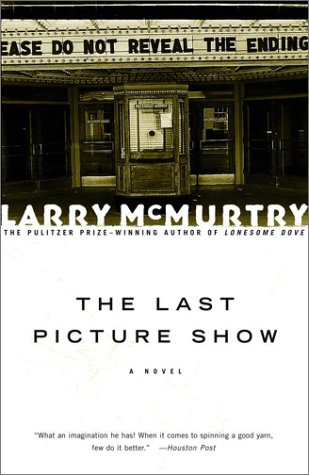
Crafted with a plainspoken power, “The Last Picture Show” is a moving coming-of-age story in mid-century nowhere Texas.
Based in the fading oil town of Thalia, the book introduces us to two friends, Sonny and Duane, as the pair head into their senior year of high school. Living together in a boarding house due to complicated family histories, the two teens haunt the pool hall, hang at the late-night diner and work long hours at hard-labor jobs.
They also look for romance, although Duane is further along that trajectory due to being in the backfield on the football team. He’s dating Jacy, a convertible-driving cutie whose parents are the richest folks in Thalia. Sonny has a crush on her too, while Jacy has her eyes on a fast-moving Wichita set.
It’s thus that Larry McMurty launches us on a year of growth and humor, loss and uncertain milestones. Thalia is a sexier place than I anticipated. There are back-door visits and steamy truck cabs and long, frustrated negotiations about what’s “too far” for high-school sweethearts. (There’s also a disturbing scene with some high-school boys and a blind heifer that I dearly hope McMurty invented. “Thank goodness I didn’t live in this time or place,” was a common thought reading the book.)
The love affairs seem amped up for effect, but the limitations of the characters’ lives feel fully realized. McMurty’s characters are earthy and real; the plainspoken dialogue is true and deeply revealing.
Sonny and Duane do their best to exceed the constraints of the town and humble backgrounds. But they’re so acclimated to the mire created by narrow-minded bullies like their Coach Popper that they don’t realize how deep they’re sunk into it.
There are heroes too, like Sam the Lion, who manages the pool hall and the titular movie theater, but they seem outnumbered and outgunned. Sonny in particular seems made for better things than what Thalia has to offer, but there’s little indication he’ll find it.
In part, this book reminded me of Cormac McCarthy’s “The Passenger.” They both carry a similar sense of loss, chronicling adventures that turn out to be elegies, even if there are some high times along the way.